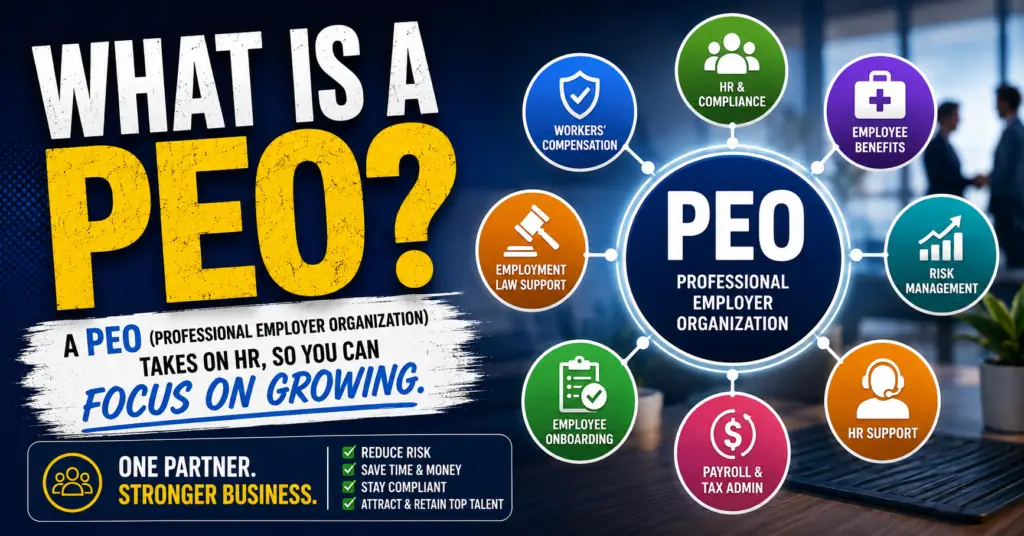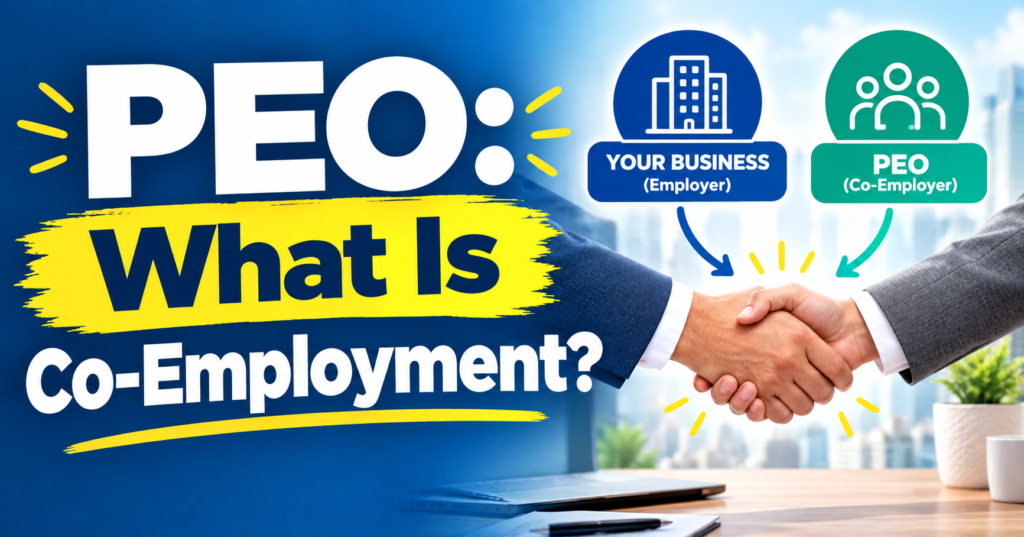
Co-employment is a shared legal arrangement between your business and a PEO (Professional Employer Organization) where both parties take on specific employer responsibilities — you keep full control of your day-to-day operations, hiring, and firing, while the PEO handles payroll, taxes, benefits administration, and HR compliance. Despite what the name implies, you do not give up your business. You do not share ownership. You stay in charge of who works for you and what they do every single day.

If you’ve heard the term co-employment and felt a wave of anxiety, you’re not alone. It’s one of the most misunderstood concepts in the PEO world — and in our experience matching hundreds of businesses with PEO providers, it’s also the number one reason owners hesitate to explore a relationship that could save them serious money and legal headaches. Let’s clear the air.

What Is Co-Employment and How Does It Actually Work?

Co-employment means two employers share legal responsibility for the same workforce. In a PEO arrangement, your employees are employed by both your company and the PEO simultaneously — but for very different purposes.

The PEO becomes the employer of record for tax and administrative purposes. That means it files payroll taxes under its own Employer Identification Number (EIN), sponsors benefit plans, manages workers’ compensation policies, and takes on certain compliance obligations. You remain the worksite employer — the one who directs the work, sets schedules, makes hiring and termination decisions, and runs the business.

Think of it this way: the PEO handles the back-office employment relationship with the government. You handle the actual employment relationship with your team.

The Legal Foundation Behind Co-Employment

The co-employment model is well-established and legally recognized across all 50 states. According to NAPEO (National Association of Professional Employer Organizations), there are more than 500 PEOs operating in the United States, collectively employing approximately 4 million workers. This isn’t a gray-area workaround — it’s a mature industry with its own regulatory framework.

The IRS formally recognized PEOs through the Tax Increase Prevention Act of 2014, which created a voluntary certification program for Certified Professional Employer Organizations (CPEOs). A CPEO carries additional financial assurances and bonding requirements, which further protects your business. You can verify CPEO status directly on the IRS website.

What the PEO Controls vs. What You Control

Here’s the breakdown that business owners actually need to see:

ResponsibilityYou (Worksite Employer)PEO (Employer of Record)
Hiring & Firing✅ Full control❌ No involvement
Day-to-Day Work Direction✅ Full control❌ No involvement
Salaries & Compensation✅ You set the ratesProcesses the payments
Payroll Tax Filing❌ Offloaded✅ PEO files under its EIN
Benefits Sponsorship❌ Offloaded✅ PEO sponsors group plans
Workers’ Comp Policy❌ Offloaded✅ PEO manages the policy + claims
HR ComplianceShared✅ PEO provides guidance & monitoring
Business Ownership/ Strategy & Clients✅ Full control❌ No involvement

Not sure if a PEO makes sense for your business? Our free calculator shows you the real cost in 60 seconds — no call, no email, no commitment.

Try the Free Calculator →

The Real Risks of Co-Employment — And What They Actually Mean for You

Let’s be honest: co-employment does come with shared liability, and you deserve a straight answer about what that looks like in practice.

Employment Practices Liability Is Shared

Because both you and the PEO are considered employers under the law, both parties can potentially be named in an employment-related lawsuit — a discrimination claim, a wrongful termination suit, a wage-and-hour dispute. This sounds alarming, but here’s the flip side: most reputable PEOs carry Employment Practices Liability Insurance (EPLI) and provide HR guidance specifically designed to help you avoid these situations in the first place.

According to the U.S. Department of Labor, employment law violations are far more common at companies without dedicated HR infrastructure — which is exactly what most small businesses lack before partnering with a PEO. In other words, the shared liability risk is real, but going it alone carries significantly greater compliance exposure.

The PEO Can’t Override Your Business Decisions

One fear we hear constantly: “What if the PEO decides to fire my employees or change my benefits without asking me?” This doesn’t happen. The PEO agreement — formally called a Client Service Agreement (CSA) — spells out exactly what each party controls. Your employees still report to you. The PEO cannot hire, fire, reassign, or discipline anyone on your team without your direction. If a PEO ever implied otherwise, that would be a red flag worth investigating before signing anything.

What Happens If You Leave the PEO?

This is a legitimate concern. When you exit a PEO relationship, payroll and benefits administration return to you (or a new provider). Employees don’t lose their jobs — they simply transition off the PEO’s benefit plans and onto whatever coverage you arrange next. The key is to plan the transition carefully, ideally with 30–90 days of lead time. Our team at PEO Marketplace walks clients through this scenario before they ever sign a contract so there are no surprises.

Why Co-Employment Is Actually a Business Advantage

Here’s the part that gets lost in the fear conversation: co-employment is the mechanism that lets small businesses access Fortune 500-level benefits, because the PEO pools hundreds or thousands of employees across its client base to negotiate group rates that no individual small business could get on its own.

According to NAPEO research, businesses in a PEO arrangement grow 7–9% faster and have 10–14% lower employee turnover than comparable companies not using a PEO. Those numbers don’t happen by accident — they’re the direct result of better benefits, better HR infrastructure, and better compliance support that co-employment makes possible.

You can use our PEO cost calculator to see exactly what those savings could look like for your headcount and industry. Most business owners are surprised by how quickly the math tips in favor of a PEO.

Co-Employment vs. Staffing Agencies: Not the Same Thing

A common misconception is that PEO co-employment works like a staffing agency, where workers are the agency’s employees and can be pulled or reassigned. That’s completely different. With a staffing agency, the agency recruits and places workers — they’re the primary employer. With a PEO, you recruit and hire your own team. The PEO just takes on the administrative employer role. Your employees are your employees, full stop.

How to Protect Yourself in a Co-Employment Arrangement

Co-employment risk is manageable when you choose the right PEO and read the contract carefully. Based on our analysis of 40+ PEO providers, here are the non-negotiables:

Look for ESAC Accreditation or CPEO Certification

The Employer Services Assurance Corporation (ESAC) accredits PEOs that meet strict financial, ethical, and operational standards. CPEO certification from the IRS adds another layer. Both signal that the PEO has the financial backing and operational discipline to honor its employer-of-record responsibilities without putting your business at risk.

Read the Client Service Agreement Carefully

The CSA defines the entire co-employment relationship. Make sure it clearly states who controls hiring and termination, how the PEO handles employment claims, what happens to benefits if you leave, and how liability is allocated. If a PEO can’t or won’t explain every clause clearly, walk away.

Compare Multiple PEOs Before You Commit

Not all PEOs structure co-employment the same way, and the contract terms vary significantly. We’ve seen providers like ADP TotalSource, Insperity, Gusto, and Justworks each take different approaches to co-employment liability and benefits sponsorship — and the differences matter. Before you sign anything, read our breakdowns on ADP TotalSource’s fee structure, Gusto vs. Justworks, and Insperity’s cost comparison to see how these providers stack up.

Or skip the research rabbit hole and let us do it for you. Our free PEO matching service cross-references your business size, industry, state, and risk profile against our vetted network of 40+ providers to find the right fit — without the sales pressure.

The Bottom Line on Co-Employment

Co-employment is not a trap. It’s a legal structure that allows small and mid-size businesses to operate with the HR infrastructure of a much larger company — while keeping complete control over their workforce, culture, and business direction. The shared liability is real, but it’s manageable, and in most cases the compliance protection a PEO provides far outweighs the theoretical downside of shared employer status.

The businesses that get burned by co-employment are usually the ones who signed with the wrong PEO, didn’t read the contract, or didn’t ask the right questions upfront. That’s exactly what we help you avoid.

Ready to Find the Right PEO for Your Business?

Book a free 15-minute consultation with a PEO Marketplace advisor. We’ll explain exactly how co-employment applies to your situation and match you with providers that fit your size, industry, and risk profile — at no cost to you.

Book Your Free Consultation →

Not ready to book a call? Get a free Benefits Benchmark Report for your industry — we will email you a breakdown of what companies your size are paying for HR, benefits, and workers comp so you can compare on your own timeline.

Get My Free Benchmark Report →

Frequently Asked Questions About Co-Employment

Does co-employment mean the PEO owns my employees?

No. Co-employment means the PEO shares certain legal employer responsibilities — primarily for tax filing, benefits administration, and compliance — but your employees report to you and you make all decisions about their work, pay, and employment status. The PEO does not own, control, or have the ability to reassign your workforce.

Can I still fire an employee if I’m in a co-employment arrangement?

Yes, absolutely. Termination decisions remain entirely with you as the worksite employer. Most PEOs will offer HR guidance on how to handle terminations compliantly to reduce your legal exposure, but the final decision is always yours. They can advise; they cannot override you.

What happens to my employees’ benefits if I leave the PEO?

When you exit a PEO, employees transition off the PEO’s group benefit plans and onto whatever new coverage you arrange — typically through a standalone broker or a new PEO. Employees do not lose coverage immediately; most agreements include a transition period. Planning the exit 60–90 days in advance prevents any gaps in coverage.

Is co-employment legal in all 50 states?

Yes. Co-employment through a PEO is legally recognized in all 50 states, though some states have specific PEO licensing or registration requirements. The IRS’s CPEO certification program, established in 2014, provides a federal framework that further legitimizes the arrangement. Always verify that your PEO is licensed to operate in your state.

How is a PEO different from a staffing agency in terms of co-employment?

With a staffing agency, the agency recruits, employs, and places workers — meaning those workers are primarily the agency’s employees, not yours. With a PEO, you hire your own employees and the PEO simply takes on the administrative employer role for tax and benefits purposes. Your employees are your team; the PEO just handles the back-office employment relationship.
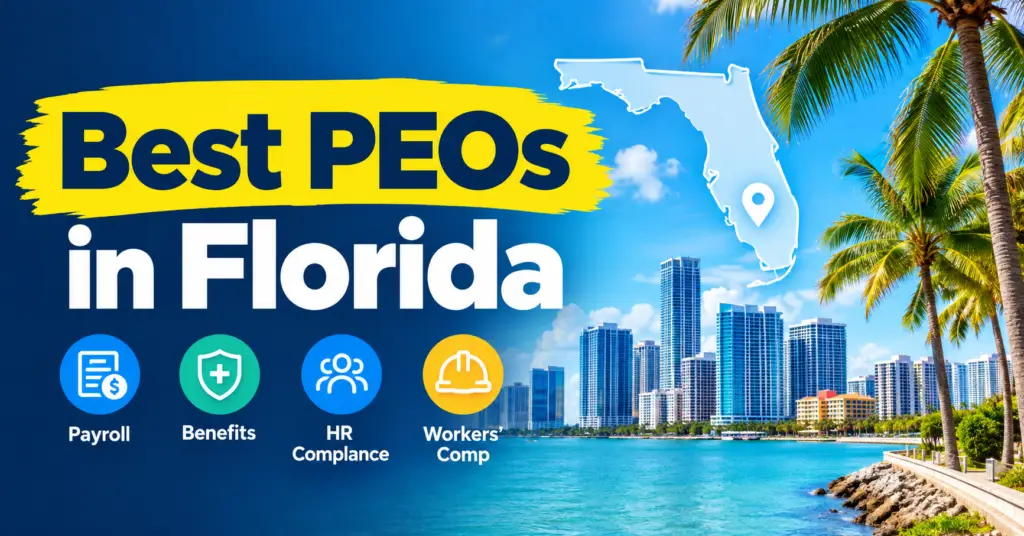
The best PEOs in Florida for small businesses in 2026 include Justworks, Insperity, Paychex PEO, ADP TotalSource, and TriNet — each offering strong benefits access, payroll compliance, and HR support tailored to Florida’s unique business environment. Florida is home to more PEO clients than any other state in the country, and for good reason: the state’s fast-growing workforce, competitive labor market, and complex workers’ comp requirements make co-employment a smart play for businesses with 5 to 500 employees. If you’re a Florida business owner evaluating your HR options, this guide breaks down the top providers, what they cost, and how to choose the right one.

Why Florida Has the Highest PEO Penetration in the US

Florida isn’t just a coincidentally popular state for PEOs — it’s structurally one of the best markets for the model to thrive. According to NAPEO (the National Association of Professional Employer Organizations), Florida consistently ranks first in the nation for PEO adoption, with thousands of small businesses operating under a co-employment arrangement at any given time.

Several factors drive this:

  • Workers’ compensation complexity: Florida’s workers’ comp system is employer-mandate-heavy and rate-sensitive. PEOs give small businesses access to lower blended rates through their master policies.
  • Rapid workforce growth: Florida added over 200,000 net new jobs in 2024 alone, according to the Bureau of Labor Statistics. Growing headcount fast creates real HR infrastructure needs.
  • Highly competitive benefits market: Attracting talent in Miami, Tampa, Orlando, and Jacksonville means competing on benefits — something PEOs make affordable for small businesses.
  • No state income tax: Florida’s tax-friendly structure makes it easier for businesses to redirect savings from PEO efficiencies into growth.
  • Concentration of small businesses: Over 2.5 million small businesses operate in Florida, making it fertile ground for PEO providers to build scale.

In our experience matching hundreds of businesses with PEO providers, Florida-based clients often come to us already aware of PEOs — they just need help choosing between competing options without getting locked into a bad contract.

Curious what a PEO would cost for a Best PEOs in Florida for Small Businesses (2026) company? Our free calculator gives you a realistic cost range in under 60 seconds — no call, no commitment.

Try the Free Calculator →

The 5 Best PEOs in Florida for Small Businesses (2026)

Based on our analysis of 40+ PEO providers and direct experience placing Florida businesses, here are the top options worth evaluating this year.

1. Justworks — Best for Small Teams and Transparent Pricing

Justworks is a strong fit for Florida businesses with 5 to 75 employees who want simple, flat-rate pricing and a clean HR platform. Their PEPM (per employee per month) pricing model makes budgeting predictable, which growing companies appreciate. Benefits access through Justworks includes medical, dental, vision, and 401(k) — all at large-group rates your small team couldn’t access independently.

For Florida specifically, Justworks handles state-specific payroll tax compliance and workers’ comp coverage, and their support team is responsive for day-to-day HR questions. The platform is modern and easy to use, which matters when you don’t have a dedicated HR person on staff.

Best for: Tech startups, professional services firms, remote-first teams in Florida
Pricing: Starts around $59–$99 PEPM depending on plan and headcount
Weakness: Less suited for businesses with complex workers’ comp classifications or heavy hourly workforces

See how Justworks stacks up in our full Gusto vs. Justworks comparison.

2. Insperity — Best for Mid-Size Florida Businesses Wanting Full-Service HR

Insperity is one of the most respected names in the PEO industry, and it’s a particularly strong fit for Florida businesses with 20 to 150 employees that want hands-on HR support, not just a software platform. They assign a dedicated HR team to your account, which is a real differentiator when you’re navigating hiring, terminations, or compliance issues in real time.

Insperity’s benefits package is competitive, and their HR technology suite covers recruiting, learning management, performance management, and time tracking. For Florida companies in industries like healthcare, construction, or financial services — where compliance is non-negotiable — Insperity’s depth of expertise stands out.

Best for: Established Florida businesses in regulated industries, companies scaling from 25 to 150 employees
Pricing: Typically 2%–4% of gross payroll; tends to be premium-priced
Weakness: Cost can be high for very small teams; less flexible contract terms

Get the full picture in our Insperity cost comparison guide.

3. ADP TotalSource — Best for Businesses That Want Brand Stability and Deep Integrations

ADP TotalSource is ADP’s fully certified PEO offering, and it carries the weight of ADP’s massive infrastructure. For Florida businesses already using ADP Payroll or RUN, TotalSource is a natural upgrade path that preserves existing integrations and data history. It’s also one of the few PEOs with both IRS Certified PEO (CPEO) status and ESAC accreditation — which matters for tax liability protection under IRS rules.

Florida-based clients benefit from ADP’s large workers’ comp carrier network, which can be particularly valuable in industries like hospitality, landscaping, and construction — all common in Florida. The platform is robust but can feel complex for smaller teams without dedicated HR staff.

Best for: Florida businesses with 30+ employees, existing ADP users, companies in high-risk workers’ comp industries
Pricing: Quote-based; typically competitive for mid-market but can include hidden fees
Weakness: Sales process can be aggressive; watch for contract terms

Before you sign, read our breakdown of hidden fees with ADP TotalSource.

4. Paychex PEO — Best for Florida Businesses That Want Local Presence

Paychex has one of the largest physical footprints of any PEO, with offices throughout Florida including Miami, Tampa, and Orlando. For business owners who want a local account rep they can actually meet with, Paychex PEO is a serious option. Their PEO product includes payroll, HR administration, benefits, and workers’ comp — all under one roof.

Paychex is especially strong for Florida businesses in industries with variable payroll like hospitality, food service, and retail, where managing complex pay schedules and high turnover is a real operational burden. Their technology has improved significantly in recent years, though it still lags behind Justworks or Rippling in user experience.

Best for: Florida businesses that value local support, hourly workforce management, hospitality and retail sectors
Pricing: Quote-based; PEPM or percentage of payroll depending on size
Weakness: Platform UX is less modern; benefits options narrower than some competitors

5. TriNet — Best for Florida Businesses in Niche or High-Compensation Industries

TriNet differentiates itself by offering industry-specific PEO solutions — meaning your HR, benefits, and compliance support is tailored to your sector rather than generic. For Florida businesses in tech, life sciences, financial services, or professional services, TriNet’s vertical expertise is a meaningful advantage over generalist PEOs.

Their benefits packages are strong and include access to major carriers at rates that are genuinely competitive for small teams. TriNet also offers robust HR technology with self-service capabilities that employees actually use. Keep in mind that TriNet tends to price at the premium end of the market.

Best for: Florida tech companies, financial services firms, life sciences businesses
Pricing: PEPM-based; typically $150–$250+ PEPM all-in depending on benefits selection
Weakness: Cost can be a barrier for very small teams; some clients report service variability

Florida PEO Comparison Table (2026)

PEO ProviderBest ForPricing ModelCPEO CertifiedFL Local Support
JustworksSmall teams, transparent pricingFlat PEPMYesRemote/online
InsperityMid-size, full-service HR% of payrollYesYes (multiple FL offices)
ADP TotalSourceBrand stability, integrationsQuote-basedYesYes
Paychex PEOLocal presence, hourly workforceQuote-basedYesYes (statewide)
TriNetNiche industries, high-comp rolesFlat PEPMYesRemote/online

How to Choose the Right PEO for Your Florida Business

Choosing the right PEO isn’t just about picking the biggest name — it’s about matching your specific situation to the right service model, price point, and industry expertise. Here’s how to think through the decision.

Start With Your Employee Count and Industry

PEO pricing and service models are heavily influenced by headcount. Businesses under 20 employees typically get the most value from flat-rate PEPM providers like Justworks. Businesses between 25 and 100 employees often benefit from full-service providers like Insperity or ADP TotalSource. Industry also matters — high workers’ comp risk industries (construction, landscaping, healthcare) should prioritize PEOs with strong carrier relationships in those classifications.

Verify CPEO Certification

A Certified PEO (CPEO) status from the IRS means the PEO has met specific financial, background, and reporting standards. Under a CPEO arrangement, the PEO — not your business — is solely responsible for payroll taxes on wages it pays. This is a meaningful liability protection. You can verify CPEO status directly through the IRS CPEO directory. All five providers on this list hold CPEO certification.

Understand What’s Included vs. Add-On

The base PEO fee rarely covers everything. Ask every provider to itemize what’s included in the base rate versus what costs extra — recruiting support, EPLI coverage, learning management systems, and HR consulting hours are commonly excluded. In our experience matching hundreds of businesses, the biggest source of buyer’s remorse is discovering mid-contract that the services they assumed were included cost more.

Get Multiple Quotes and Compare Apples to Apples

PEO proposals aren’t standardized, which makes comparison hard. Use our free PEO matching service to get vetted quotes from multiple providers formatted for direct comparison — it’s the fastest way to find a fair price without spending hours on sales calls.

What Florida Business Owners Should Know About PEO ROI

The business case for using a PEO in Florida is well documented. According to NAPEO, companies that use a PEO grow 7–9% faster than comparable businesses that don’t, have 10–14% lower employee turnover, and are 50% less likely to go out of business. For a Florida small business competing for talent in a tight labor market, those numbers translate directly to real competitive advantage.

The typical ROI calculation looks like this: the cost of a PEO (usually $1,000–$2,500 per employee per year all-in) is offset by savings on benefits premiums, workers’ comp rates, HR staff costs, and avoided compliance penalties. For most Florida businesses with 10 or more employees, the math pencils out — often with money left over.

Use our PEO cost calculator to run the numbers for your specific situation before you start talking to providers.

Frequently Asked Questions

Why does Florida have so many PEO companies?

Florida has the highest PEO penetration of any US state because of its large concentration of small businesses, complex workers’ compensation requirements, and fast-growing workforce. The state’s business-friendly tax environment also makes PEO cost savings more impactful for Florida employers, driving high adoption rates across industries.

Is a PEO worth it for a Florida business with fewer than 10 employees?

A PEO can still be worth it for Florida businesses under 10 employees, particularly if you’re in a high workers’ comp risk industry or struggling to attract talent with competitive benefits. That said, the ROI is strongest for businesses with 10 or more employees — below that threshold, HR software platforms may be a more cost-effective starting point.

What’s the difference between a PEO and a payroll company in Florida?

A payroll company processes your payroll but leaves all employer liability — taxes, compliance, workers’ comp, HR — with you. A PEO enters into a co-employment relationship where it becomes the employer of record for tax and benefits purposes, sharing employer responsibilities and giving you access to better rates and reduced liability. In Florida, this distinction matters especially for workers’ comp coverage.

Do I lose control of my employees if I use a PEO in Florida?

No — you retain full control of day-to-day management, hiring decisions, and workplace culture when using a PEO. The co-employment relationship is administrative in nature, meaning the PEO handles payroll, benefits administration, and compliance while you direct the actual work. Your employees still work for you in every practical sense.

How do I find the best PEO price in Florida without calling dozens of providers?

The fastest way to compare PEO pricing in Florida without spending weeks on sales calls is to use a PEO broker or marketplace like PEO Marketplace, which can collect quotes from multiple vetted providers simultaneously and present them in a standardized format. Based on our analysis of 40+ PEO providers, businesses that compare at least three quotes save an average of 15–20% compared to going with the first provider they speak to.

Ready to Find the Right PEO for Your Florida Business?

We match Florida businesses with the right PEO from our network of 40+ vetted providers — free, unbiased, and with no pressure. Book a 15-minute call and we’ll have a shortlist ready for you.

Book Your Free PEO Consultation →

Not ready to book a call? Get a free Benefits Benchmark Report for your industry — we will email you a breakdown of what companies your size are paying for HR, benefits, and workers comp so you can compare on your own timeline.

Get My Free Benchmark Report →

Insperity and TriNet are two of the largest PEOs in the U.S., and both target mid-market businesses with 50–500 employees. Insperity leans toward white-glove HR support and benefits depth, while TriNet wins on technology and industry-specific solutions. The right choice depends heavily on your headcount, industry, and how hands-on you want your PEO to be.

Why the Insperity vs TriNet Decision Matters

Choosing between two enterprise-grade PEOs isn’t like picking a payroll tool — you’re locking into a co-employment relationship that affects your employees’ benefits, your HR infrastructure, and your bottom line. According to NAPEO, businesses that use PEOs grow 7–9% faster than those that don’t, and they see 10–14% lower employee turnover. But those numbers only hold if you pick the right provider for your size and structure.

In our experience matching hundreds of businesses to PEOs, Insperity and TriNet are the two names that come up most often when a company is scaling past 50 employees and needs enterprise-level HR muscle. They’re not the same product, though — and mistaking one for the other is an expensive mistake.

If you’ve already looked at other mid-market providers, our Insperity cost comparison gives you a broader benchmark before you read this head-to-head.

Comparing PEOs is easier when you know your baseline cost. Our free calculator shows what a PEO would cost for your company in 60 seconds — no call needed.

Try the Free Calculator →

Insperity vs TriNet: Side-by-Side Comparison

Before diving into each category, here’s a high-level snapshot of how both PEOs stack up across the dimensions that matter most to mid-market HR and finance leaders.

CategoryInsperityTriNet
Best ForBusinesses wanting deep HR supportTech, finance, and industry-focused teams
Typical Employee Range5–5,000+5–1,000+
Pricing Model% of payroll (typically 2–4%)PEPM flat fee or % of payroll
Benefits CarriersUnitedHealthcare, Aetna, MetLifeAetna, Kaiser, regional carriers
HR TechnologyWorkforce Acceleration (proprietary)TriNet HR Platform (modern UI)
Dedicated HR SupportDedicated HR team assigned to accountDedicated HR rep (varies by tier)
Contract LengthAnnual, auto-renewingAnnual, auto-renewing
IRS CPEO CertifiedYesYes
ESAC AccreditedYesYes

Pricing: What You’ll Actually Pay

Neither Insperity nor TriNet publishes a public price sheet — quotes are customized based on headcount, location, benefits elections, and risk profile. That said, based on our analysis of 40+ PEO providers, here’s what businesses typically encounter in the real world.

Insperity Pricing

Insperity typically charges a percentage of total payroll — most clients fall in the 2%–4% range, depending on company size and benefits selections. For a company with 75 employees averaging $60,000 in salary, that’s roughly $90,000–$180,000 per year in PEO fees alone, before benefits premiums. Larger accounts tend to negotiate toward the lower end. Insperity bundles most HR services into the base fee, so what you see is usually what you get — though technology add-ons can push costs up. See our full Insperity cost breakdown for more detail.

TriNet Pricing

TriNet offers both a per-employee-per-month (PEPM) flat fee and a percentage-of-payroll model, depending on the product tier and industry vertical. PEPM fees typically range from $80–$200 per employee per month for the HR platform, with benefits priced separately. TriNet’s modular structure can look cheaper upfront, but watch for add-on fees for things like onboarding, reporting, or premium support tiers. For a deeper look at how hidden fees can accumulate with large PEOs, our guide on hidden PEO fees applies principles that are equally relevant here.

Benefits: Carriers, Plan Quality, and Employee Choice

Benefits quality is often the real reason a mid-market company switches PEOs — or stays put. Both Insperity and TriNet offer Fortune 500-caliber benefits through co-employment purchasing power, but the carrier mix and plan flexibility differ significantly.

Insperity Benefits

Insperity partners with UnitedHealthcare, Aetna, and MetLife as primary medical carriers. Their benefits portfolio is broad — medical, dental, vision, life, disability, FSA, HSA, and 401(k) with multiple investment options. Insperity’s 401(k) is a standout: it’s a multiple employer plan (MEP) with institutional fund access that most small and mid-size businesses couldn’t access on their own. The enrollment experience is managed through their proprietary platform, and employees generally rate the plan selection experience positively.

TriNet Benefits

TriNet built its reputation in part on offering industry-specific benefits packages — particularly for tech startups, financial services firms, and nonprofits. Carriers include Aetna, Kaiser (in applicable markets), and regional plans. TriNet’s health plan options tend to skew toward higher-end, lower-deductible plans that appeal to white-collar workforces competing for talent. Their benefits administration technology is generally considered more modern and employee-friendly than Insperity’s. However, plan availability varies significantly by geography, which can be a problem for companies with distributed teams.

HR Technology: Platforms and Integrations

The quality of a PEO’s tech platform affects daily life for your HR team and your employees. In 2026, this is no longer a secondary consideration — it’s table stakes.

Insperity’s Workforce Acceleration Platform

Insperity’s proprietary platform, Workforce Acceleration, covers payroll, time tracking, benefits administration, performance management, and HR analytics. It’s functional and feature-rich, but longtime users note the interface feels dated compared to newer entrants. The platform integrates with common tools like QuickBooks and several ATS systems, but deep API integrations require custom work. Reporting is solid, especially for compliance and workforce analytics.

TriNet HR Platform

TriNet’s HR Platform is widely regarded as one of the more modern UX experiences among enterprise PEOs. The mobile app is polished, employee self-service is intuitive, and the analytics dashboard gives HR leaders visibility into headcount, compensation, and turnover trends in real time. TriNet also acquired Zenefits infrastructure and has invested heavily in integration capabilities — it connects cleanly with Slack, Greenhouse, Rippling-style tools, and popular accounting platforms. If your team lives in their phones or expects a consumer-grade HR experience, TriNet has an edge here.

Support Models: Who Picks Up the Phone?

Support quality is the most underrated factor in PEO selection — and the one that causes the most regret after signing. According to the Bureau of Labor Statistics, HR compliance errors cost employers billions annually in penalties and litigation. Having a responsive HR partner isn’t optional.

Insperity Support

Insperity’s differentiator has always been its dedicated HR team model. Most mid-market accounts get an assigned HR specialist (or small team) who learns your business, your culture, and your workforce. Response times tend to be faster, and the relationship feels more like an internal HR partner than a vendor helpdesk. For businesses that want a true extension of their HR function, this is Insperity’s strongest argument.

TriNet Support

TriNet also offers dedicated HR support, but the consistency varies by tier and account size. Smaller accounts may find themselves routed through a shared service model more often than they’d like. That said, TriNet’s industry-vertical specialists are a real asset — if you’re in fintech or life sciences, having an HR rep who understands your compliance landscape (think SOX, HIPAA, or SEC considerations) adds genuine value. TriNet also maintains a robust online knowledge base and compliance alert system that proactive HR teams find useful.

Contract Terms and Exit Flexibility

Both Insperity and TriNet use annual contracts that auto-renew. Neither is notorious for predatory termination clauses, but there are nuances worth understanding before you sign.

Insperity typically requires 30–60 days written notice before your renewal date to avoid automatic rollover. Mid-year exits are possible but may trigger early termination fees tied to benefits administration costs already incurred. TriNet’s contracts are structured similarly, with notice requirements of 30–90 days depending on the agreement. Always negotiate the exit terms before signing — and make sure your benefits transition timeline is explicitly addressed in the contract language. The IRS CPEO certification both providers hold does offer some tax protections, but it doesn’t affect how exit clauses work.

If you’re still weighing whether a PEO is right at all, our Gusto vs Justworks comparison covers lighter-weight options that may suit earlier-stage companies better.

Which One Should You Choose?

Based on our analysis of 40+ PEO providers and hundreds of matching conversations, here’s the honest breakdown:

Choose Insperity if: You want a dedicated HR team that functions like an extension of your business. You value benefits depth (especially the 401(k) MEP), you have complex multi-state compliance needs, or you’re in a regulated industry where HR mistakes are expensive. Insperity tends to win with professional services firms, healthcare-adjacent businesses, and any company where HR is genuinely strategic.

Choose TriNet if: You’re in tech, finance, or another industry where TriNet’s vertical expertise shines. Your employees expect a modern, mobile-first HR experience. You want more flexibility in how you pay (PEPM vs. percentage), or your headcount is under 100 and you want enterprise benefits without enterprise complexity.

Neither is universally better. The right call depends on your specific mix of headcount, geography, industry, and how hands-on you want your PEO relationship to be. That’s exactly why a guided matching process matters — the pricing alone doesn’t tell the whole story.

Not Sure Which PEO Is Right for You?

We’ve vetted 40+ PEO providers — including Insperity and TriNet — and match businesses to the right fit based on size, industry, and budget. No sales pitch. Just a straight answer.

Book a Free PEO Consultation →

Not ready to book a call? Get a free Benefits Benchmark Report for your industry — we will email you a breakdown of what companies your size are paying for HR, benefits, and workers comp so you can compare on your own timeline.

Get My Free Benchmark Report →

Frequently Asked Questions

Is Insperity or TriNet cheaper?

It depends on your headcount and benefits elections — neither publishes standard pricing. Insperity typically charges 2–4% of payroll, while TriNet offers PEPM flat fees ranging from $80–$200 per employee per month. For many mid-size businesses with 50–150 employees, TriNet’s PEPM model can come out cheaper, but Insperity’s bundled services may offer more value per dollar when you factor in dedicated HR support.

Can I switch from Insperity to TriNet mid-year?

Technically yes, but mid-year PEO switches are disruptive — especially for employees enrolled in active benefits plans. Most businesses switch at the start of a new plan year to avoid mid-year benefits transitions, and you’ll need to honor your current contract’s exit notice requirements before initiating a switch.

Are both Insperity and TriNet IRS-certified PEOs?

Yes. Both Insperity and TriNet hold IRS Certified PEO (CPEO) status, which means they’ve met stringent financial, background, and reporting standards set by the IRS. CPEO certification also provides specific tax protections for client companies, particularly around employment tax liability. You can verify CPEO status directly on the IRS website.

Which PEO is better for remote or distributed teams?

TriNet generally handles distributed workforces more smoothly, particularly because its HR platform is built for remote-first employee experiences and its benefits offerings include national-level carrier networks. Insperity also supports multi-state employers well, but its benefits carrier availability can be more geographically variable depending on your employee locations.

Do Insperity and TriNet work with small businesses under 20 employees?

Both will technically work with smaller businesses, but their pricing and service models are optimized for companies with 25+ employees. Below that threshold, you may find better cost-per-employee value with a smaller PEO or HR platform. Use our free PEO cost calculator to benchmark what makes sense at your current headcount before committing to either provider.

CoAdvantage is a regional PEO primarily serving small and mid-size businesses in the Southeast U.S., offering payroll, HR administration, benefits, and workers’ comp coverage under a co-employment model. It is a solid option for certain employers, but its limited geographic footprint and opaque pricing make it a poor fit for many growing companies. This review covers what CoAdvantage costs, where it excels, where it falls short, and which alternatives are worth considering.

What Is CoAdvantage and How Does It Work?

CoAdvantage is a Professional Employer Organization (PEO) founded in 1997 and headquartered in Bradenton, Florida. Under a co-employment arrangement, CoAdvantage becomes the employer of record for your workforce — handling payroll taxes, benefits enrollment, HR compliance, and workers’ compensation. You retain full control over day-to-day management and hiring decisions.

CoAdvantage is ESAC accredited (Employer Services Assurance Corporation), which means it meets strict financial and ethical standards — a meaningful trust signal when you’re handing over payroll and tax responsibilities. According to NAPEO, businesses that use PEOs grow 7–9% faster and have 10–14% lower employee turnover than those that don’t — but only when the PEO is the right fit.

CoAdvantage primarily targets companies with 5 to 500 employees and has a strong concentration of clients in Florida, Georgia, Texas, and the broader Southeast. Its technology platform has improved in recent years but still lags behind larger national players in terms of self-service capability and integrations.

Not sure if a PEO makes sense for your business? Our free calculator shows you the real cost in 60 seconds — no call, no email, no commitment.

Try the Free Calculator →

CoAdvantage Pricing: What Does It Actually Cost?

CoAdvantage does not publish its pricing publicly, which is common in the PEO industry but frustrating for buyers doing early-stage research. Based on our analysis of 40+ PEO providers at PEO Marketplace, CoAdvantage typically prices its services in one of two ways:

  • Percentage of gross payroll: Generally ranges from 2% to 5% depending on company size, industry, and benefit selections.
  • Per-employee-per-month (PEPM) flat fee: Typically falls between $125 and $200 PEPM for bundled HR services.

Workers’ compensation and benefits are typically quoted separately and can significantly affect your all-in cost. If your workforce is in a high-risk classification code (construction, manufacturing, logistics), your workers’ comp premium will drive the total cost up considerably. Always ask for a full fee disclosure before signing — and watch for hidden line items. Our guide on hidden fees with PEO contracts covers exactly what to look for.

CoAdvantage does not typically require long-term contracts, which is a genuine advantage for smaller businesses that are still testing the PEO model. However, early termination clauses and setup fees do vary — get everything in writing.

CoAdvantage Pros and Cons

What CoAdvantage Does Well

  • ESAC and IRS-certified PEO (CPEO): Both accreditations matter — CPEO status from the IRS means you get important tax liability protections that uncertified PEOs cannot offer.
  • Strong regional relationships: CoAdvantage has built carrier relationships specifically for Southeast markets, which can translate into better health insurance rates for Florida and Georgia employers.
  • Dedicated HR support: Clients consistently report responsive, knowledgeable HR business partners — not just a call center.
  • No long-term lock-in: Month-to-month flexibility is a real differentiator for companies in early growth stages.
  • Hands-on implementation: Onboarding is more guided than you’d get from self-service platforms like Gusto or Justworks.

Where CoAdvantage Falls Short

  • Limited national presence: If you have employees outside the Southeast, carrier options and HR support quality can drop off noticeably.
  • Technology platform: The employee self-service portal and payroll dashboard are functional but not modern. Integration with popular tools like QuickBooks, Slack, or ATS platforms is limited compared to Rippling or ADP TotalSource.
  • Opaque pricing: No online quote engine means you must go through a sales rep to get numbers, adding friction to your evaluation process.
  • Smaller benefits marketplace: Fewer voluntary benefit options and less carrier variety compared to national PEOs with 100,000+ covered lives.
  • Scaling challenges: Businesses that grow past 300–400 employees often find CoAdvantage’s service model less flexible than enterprise-tier PEOs.

Who Is CoAdvantage Best For?

CoAdvantage is a genuinely good fit for a specific type of employer. In our experience matching hundreds of businesses with PEO providers, CoAdvantage tends to work best when:

  • Your employees are concentrated in Florida, Georgia, Texas, or the broader Southeast
  • You have 10–150 employees and want a mid-market PEO with more personal service than a self-service platform
  • Your industry has elevated workers’ comp risk and you need a PEO with strong risk management capabilities
  • You want CPEO-certified tax protections without paying Insperity or ADP prices
  • You’re new to PEOs and want a guided, high-touch onboarding experience

CoAdvantage is not the best fit if you’re scaling nationally, need deep tech integrations, or want a wide benefits marketplace to compete for talent in high-cost metros.

Top 3 CoAdvantage Alternatives for 2026

Before committing to any PEO, you should benchmark it against at least two or three alternatives. Here’s how CoAdvantage stacks up against the most common competitors we see in head-to-head comparisons.

1. Insperity — Best for Service-Heavy Mid-Market Companies

Insperity is one of the largest PEOs in the U.S. and consistently earns high marks for HR support quality and benefits depth. It’s more expensive than CoAdvantage — typically $150–$220 PEPM — but the benefits purchasing power and dedicated service team justify the premium for companies with 50+ employees. Check out our Insperity cost comparison for a full breakdown. Best for companies that want enterprise-quality service without building an internal HR team.

2. Justworks — Best for Tech-Forward Small Businesses

Justworks is a PEO built on a modern, transparent platform with flat PEPM pricing starting around $59–$109 per employee per month depending on the plan. It’s a strong option for remote-first companies and startups that want self-service simplicity and competitive benefits access. The tradeoff: less hands-on HR support and limited workers’ comp handling for complex industries. See our Gusto vs. Justworks comparison to understand where each fits.

3. ADP TotalSource — Best for Multi-State and Enterprise Growth

ADP TotalSource is the right choice if you’re growing nationally or need deep payroll compliance across multiple states. It offers the broadest tech integration library in the industry and strong enterprise HR tools. Pricing is higher and less transparent — and the sales process can be aggressive. Read our ADP TotalSource hidden fees guide before you sign. Best for companies with 100+ employees that need a PEO with true national scale.

CoAdvantage vs. Alternatives: Quick Comparison

ProviderBest ForEst. PricingTech PlatformCPEO Certified
CoAdvantageSoutheast SMBs, high-touch service$125–$200 PEPMModerate✅ Yes
InsperityMid-market, service-heavy HR$150–$220 PEPMStrong✅ Yes
JustworksStartups, remote-first teams$59–$109 PEPMExcellent✅ Yes
ADP TotalSourceMulti-state, enterprise growth$175–$250+ PEPMBest in class✅ Yes

The Bottom Line: Is CoAdvantage Worth It in 2026?

CoAdvantage is a legitimate, accredited PEO that delivers real value for the right business — particularly Southeast-based companies with 10–150 employees that want personal HR support and strong workers’ comp management. It is not the right call for companies scaling nationally, those that need robust tech integrations, or businesses that want transparent self-serve pricing upfront.

The honest answer is that no PEO is universally the best. The right choice depends on your headcount, industry, state footprint, and what you actually need HR to do for you. That’s exactly why we built PEO Marketplace’s matching service — to help you compare vetted providers side by side without pressure from any single vendor’s sales team.

According to the U.S. Department of Labor, employment law complexity continues to grow — making the compliance backstop of a CPEO-certified PEO increasingly valuable for small businesses operating in multiple states or regulated industries. Whether that’s CoAdvantage or one of its competitors depends on your specific situation.

Ready to see how CoAdvantage stacks up against the right PEOs for your business?

Book a Free PEO Comparison Call →

Not ready to book a call? Get a free Benefits Benchmark Report for your industry — we will email you a breakdown of what companies your size are paying for HR, benefits, and workers comp so you can compare on your own timeline.

Get My Free Benchmark Report →

Frequently Asked Questions

Is CoAdvantage a good PEO?

CoAdvantage is a good PEO for small and mid-size businesses in the Southeast U.S. that want high-touch HR support and strong workers’ compensation management. It is ESAC accredited and IRS-certified as a CPEO, making it a financially sound and legally reliable choice. However, it is not the best fit for companies that need national coverage, robust tech integrations, or a wide benefits marketplace.

How much does CoAdvantage cost?

CoAdvantage does not publish pricing online, but based on market data it typically charges between $125 and $200 per employee per month for bundled HR services, or 2–5% of gross payroll. Workers’ compensation and benefits are usually quoted separately and can significantly affect your all-in cost. Always request a full fee disclosure and compare at least two or three PEO quotes before deciding.

What is the difference between CoAdvantage and Insperity?

Both CoAdvantage and Insperity are CPEO-certified PEOs offering payroll, benefits, and HR compliance, but Insperity operates on a larger national scale with deeper benefits purchasing power and more enterprise-grade HR tools. CoAdvantage tends to cost less and offers more personalized regional service, particularly in Florida, Georgia, and Texas. Insperity is generally a better fit for companies with 50–500 employees that are growing multi-state and need more comprehensive HR infrastructure.

Does CoAdvantage require a long-term contract?

CoAdvantage generally does not require multi-year contracts and offers more flexible month-to-month arrangements than some larger PEOs. However, specific terms including setup fees, early termination clauses, and notice periods can vary by contract. Always review the agreement with a qualified advisor before signing and clarify cancellation terms in writing.

How do I know if I should switch from CoAdvantage to another PEO?

Signs it may be time to switch include rapid headcount growth beyond 200–300 employees, expanding operations into new states where CoAdvantage lacks strong carrier relationships, frustration with the technology platform, or finding significantly better benefits pricing through a competitor. Use our free PEO cost calculator to benchmark your current spend and see how alternatives compare before making any changes.

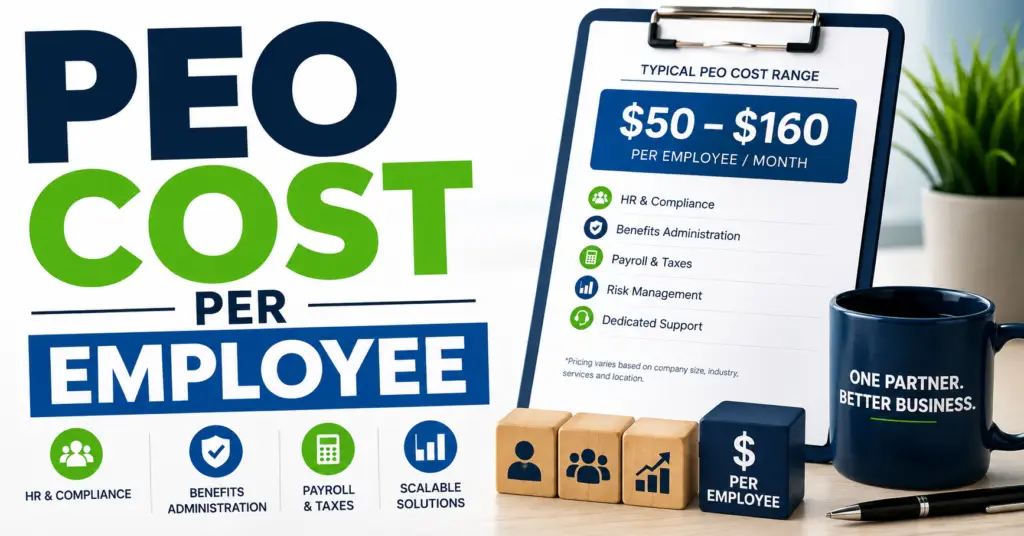
A PEO typically costs between $80 and $180 per employee per month (PEPM), or roughly 2% to 12% of your total annual payroll. The wide range exists because pricing depends on your industry, headcount, benefits selections, and which pricing model the PEO uses. Understanding PEO cost per employee before you start shopping puts you in a much stronger position to evaluate quotes and avoid paying for services you don’t need.

What Is PEO Pricing and How Does It Work?

A PEO — Professional Employer Organization — enters a co-employment arrangement with your business, handling payroll, benefits administration, HR compliance, and workers’ compensation under a shared employer structure. You pay for that service in one of two ways: a flat per-employee-per-month fee, or a percentage of your total payroll. Some providers blend both models.

According to NAPEO, businesses that use PEOs grow 7–9% faster and have 10–14% lower employee turnover than those that manage HR independently. That ROI context matters when you’re evaluating cost — you’re not just paying for administration, you’re buying access to Fortune 500-level benefits pricing, compliance infrastructure, and shared HR expertise.

In our experience matching hundreds of businesses across 40+ vetted PEO providers, most small and mid-size companies land somewhere between $100 and $150 PEPM when you account for their actual headcount and payroll structure. Here’s how the full picture breaks down.

Bundled vs. Unbundled PEO Pricing: What’s the Difference?

The two dominant pricing structures you’ll encounter are bundled (all-inclusive) and unbundled (à la carte). Choosing the wrong model for your business is one of the most common ways companies overpay for a PEO.

Bundled Pricing

Bundled pricing packages all core services — payroll processing, HR support, compliance, benefits administration, and sometimes workers’ comp — into a single PEPM or payroll percentage fee. Providers like Insperity and TriNet typically use this approach. It’s predictable and easy to budget, but you may pay for features you never use.

Unbundled Pricing

Unbundled pricing lets you select specific services and pay only for what you need. This can be more cost-effective for companies that already have robust internal HR or don’t need the full suite of benefits administration tools. The tradeoff is that add-ons can stack up quickly and make it harder to do apples-to-apples comparisons between providers.

If you’re comparing specific providers, our deep dives on Insperity’s cost structure versus other PEOs and Gusto vs. Justworks pricing give you a real side-by-side look at how these models play out in practice.

Want to see the actual numbers before talking to anyone? Our free PEO calculator gives you a realistic cost range based on your company size and payroll — no commitment, no call.

Try the Free Calculator →

PEO Cost Per Employee: Real Numbers by Company Size

Based on our analysis of 40+ PEO providers and real quotes we’ve seen across client engagements, here’s what businesses actually pay at different headcount levels in 2026.

Company SizeTypical PEPM Range% of Payroll RangeNotes
1–10 employees$130–$180 PEPM8–12%Higher per-head cost; some PEOs have minimums
11–50 employees$100–$150 PEPM4–8%Sweet spot for most PEO providers
51–150 employees$80–$120 PEPM3–6%Strong negotiating leverage; bundled deals improve
150+ employees$80–$100 PEPM2–4%May be approaching threshold for self-insured benefits

These ranges reflect admin fees only. They do not include the cost of the benefits themselves — health insurance, dental, vision, 401(k) — which are passed through separately based on your employee elections.

What’s Actually Included in PEO Fees?

Not every provider defines “included” the same way. Here’s what the core admin fee typically covers — and what tends to be an add-on.

Usually Included in the Base Fee

  • Payroll processing and direct deposit
  • Payroll tax filing (federal, state, local)
  • New hire onboarding and paperwork
  • HR compliance support and policy templates
  • Access to benefits administration platform
  • Workers’ compensation coverage (in most cases)
  • Employer Practices Liability Insurance (EPLI) access

Often Billed Separately or as Add-Ons

  • 401(k) plan administration fees
  • Time and attendance software
  • ATS or applicant tracking tools
  • Performance management modules
  • State unemployment insurance management
  • Out-of-state employee setup fees
  • Termination or offboarding processing fees

This is exactly why we wrote our guide on hidden fees to watch for with ADP TotalSource — some of the biggest national PEOs are skilled at quoting low base rates and padding the contract with line-item surprises.

The 5 Biggest Factors That Drive Your PEO Cost Per Employee

Your quote isn’t random. PEO underwriters look at specific risk and complexity signals to set your pricing. Here’s what moves the number most.

1. Industry and Workers’ Comp Risk Class

A tech company with 20 remote employees and a construction firm with 20 field workers will get dramatically different quotes. High-risk industries — construction, manufacturing, healthcare, transportation — carry elevated workers’ comp modifier rates, which directly increases your PEO cost. The Bureau of Labor Statistics injury and illness data is what actuaries use to establish those risk classes.

2. Total Payroll Volume

For percentage-based pricing, higher payroll means higher fees in absolute dollars — even if the percentage itself stays flat. For PEPM pricing, payroll volume influences negotiating power. A company paying $5M in annual wages has far more leverage than one at $500K.

3. Employee Benefits Elections

The benefits themselves — medical, dental, vision, life, disability — are separate from the admin fee, but your benefits tier selection affects how the PEO prices the overall relationship. Richer plan elections tend to attract younger, healthier workforces, which can actually reduce risk pricing over time.

4. Multi-State Operations

Every state you operate in adds compliance complexity. Multi-state employers should expect higher base fees or per-state surcharges because the PEO has to maintain compliance infrastructure across multiple jurisdictions. The Department of Labor maintains state-by-state wage and hour requirements that PEOs must track and apply correctly.

5. Contract Length and Commitment

Annual contracts almost always yield better pricing than month-to-month arrangements. If you’re confident in your provider choice, committing to a 12 or 24-month term can shave 5–10% off your PEPM rate with most providers.

PEO Cost vs. Doing It In-House: The Real Comparison

The honest question isn’t just “how much does a PEO cost?” — it’s “how much does NOT using a PEO actually cost?” Consider what you’re replacing or supplementing:

  • HR manager salary: $65,000–$95,000/year fully loaded (salary + benefits + payroll taxes)
  • Payroll software: $1,200–$6,000/year depending on headcount
  • Benefits broker fees and administration: $500–$2,500/year
  • Employment law compliance counsel: $3,000–$15,000/year on retainer
  • Workers’ comp policy (standalone): Often 20–40% more than PEO group rates

NAPEO research consistently shows that PEO clients save an average of $1,775 per employee per year when total HR costs are compared side-by-side. For a 25-person company, that’s roughly $44,000 in annual savings — before accounting for the time your leadership team gets back.

Use our free PEO cost calculator to run the numbers for your specific headcount and payroll. It takes about 90 seconds and gives you a realistic range without requiring you to talk to a salesperson first.

How to Get a Fair PEO Quote (And Not Overpay)

Getting multiple quotes is the single most effective thing you can do. In our experience, businesses that only talk to one PEO overpay by 15–25% compared to those who run a competitive process. Here’s what to do:

  • Request itemized pricing — don’t accept a single blended number without a breakdown of what’s included
  • Ask for the workers’ comp rate separately — some providers embed it in the PEPM in a way that obscures the real cost
  • Compare implementation fees — these range from $0 to $2,000+ depending on the provider
  • Clarify renewal pricing — some PEOs offer a low first-year rate and increase significantly at renewal
  • Check ESAC and IRS certification — certified PEOs offer stronger compliance guarantees and tax benefits under IRC §3511

If you’d rather have an expert run this process for you, our free PEO matching service compares quotes from multiple vetted providers and gives you an unbiased recommendation based on your business profile — at no cost to you.

Ready to See What PEOs Will Actually Charge Your Business?

We match you with the right PEO from our network of 40+ vetted providers — free, unbiased, and on your timeline. Book a 20-minute call and we’ll do the comparison work for you.

Book a Free Consultation →

Not ready to book a call? Get a free Benefits Benchmark Report for your industry — we will email you a breakdown of what companies your size are paying for HR, benefits, and workers comp so you can compare on your own timeline.

Get My Free Benchmark Report →

Frequently Asked Questions

What is the average PEO cost per employee per month?

The average PEO cost per employee per month ranges from $80 to $180 PEPM in 2026, with most small and mid-size businesses landing between $100 and $150 PEPM depending on their industry, headcount, and selected services. This fee covers administration only — the cost of health insurance and other benefits is separate and based on employee elections.

Is PEO pricing based on per employee or percentage of payroll?

PEOs use both models, and the right choice depends on your average employee salary. If your average annual salary per employee is above $60,000, a flat PEPM rate typically works out cheaper than a percentage-of-payroll model. Lower average salaries often make percentage-based pricing more favorable.

Are there hidden fees with PEOs I should watch out for?

Yes — implementation fees, out-of-state setup charges, termination fees, and 401(k) administration costs are commonly excluded from base quotes. Always request an itemized contract and ask specifically about fees for state registrations, offboarding, and mid-year plan changes before signing.

How many employees do you need before a PEO makes financial sense?

Most PEOs have minimum headcount requirements of 3–5 employees, but the financial break-even point for most businesses is around 10–15 employees, where the cost of dedicated HR infrastructure starts to exceed PEO fees. Some providers, particularly those targeting very small businesses, offer competitive pricing starting at just one or two employees.

Do PEO fees include health insurance costs?

No — PEO admin fees and health insurance premiums are two separate line items. The PEO gives you access to its group health plan at negotiated rates, but the actual premium cost is determined by your employees’ plan elections and the carrier’s rates for your group. You pay the admin fee to the PEO and the premium cost to the carrier (often invoiced together).

The Short Answer: Which PEO Is Best for Construction Companies?

The best PEO for construction companies is one that offers industry-specific workers’ compensation coverage, a dedicated safety program, multi-state payroll capability, and prevailing wage compliance support. Based on our analysis of 100+ PEO providers at PEO Marketplace, FrankCrum, Peoplease, and Southeast Personnel Leasing (SPLI) consistently rank highest for construction-specific needs — but the right fit depends on your crew size, states of operation, and risk profile.

Construction is one of the most complex industries for HR and compliance. Between fluctuating headcounts, job-site safety requirements, certified payroll for government contracts, and workers’ comp premiums that can eat 15–30% of payroll, choosing the wrong PEO isn’t just inconvenient — it’s expensive. This guide gives you the insider knowledge to make the right call in 2026.

Why Construction Companies Need a Specialized PEO

A standard PEO handles payroll, benefits, and basic HR. A construction-ready PEO goes several layers deeper. Here’s why the industry demands more from an HR partner.

Workers’ Compensation Is the Biggest Cost Driver

Construction consistently ranks among the highest-risk industries in the U.S. According to the Bureau of Labor Statistics, construction accounts for roughly 20% of all private-sector workplace fatalities despite representing a much smaller share of the workforce. That risk translates directly into workers’ comp premiums that can be 5–10x higher than office-based businesses.

A PEO pools employees across many clients, which lets them negotiate significantly lower workers’ comp rates through master policies. For a construction company paying $400,000 annually in workers’ comp, even a 20% reduction saves $80,000 per year. That alone can justify the entire cost of PEO services.

OSHA Safety Compliance Is Non-Negotiable

OSHA citations in construction averaged over $15,000 per serious violation in 2024 — and repeat violations can reach six figures. A specialized PEO doesn’t just file paperwork; they provide safety manuals, site inspection checklists, toolbox talk programs, and incident reporting systems that reduce your exposure before an inspector shows up.

Multi-State Crews Create Payroll and Licensing Complexity

If your crews cross state lines — and most mid-size contractors do — you’re dealing with multiple state tax registrations, varying workers’ comp requirements, different overtime rules, and sometimes conflicting labor laws. A PEO with multi-state payroll infrastructure handles this automatically, reducing your compliance risk and administrative overhead dramatically.

Prevailing Wage and Certified Payroll Requirements

Public works and government contracts require certified payroll reporting under the Davis-Bacon Act and state equivalents. This means tracking wage rates by job classification, submitting weekly certified payroll reports, and maintaining audit-ready documentation. Few generic PEOs handle this well. Construction-focused PEOs build certified payroll workflows directly into their platforms.


Curious what a PEO would cost for your construction company in 2026? Our free calculator gives you a realistic cost range in under 60 seconds — no call, no commitment.

Try the Free Calculator →


What to Look for in a PEO for Construction Companies

Not every PEO accepts high-hazard industries. Of the 40+ providers we’ve vetted at PEO Marketplace, roughly half either decline construction clients outright or charge prohibitive rates for certain trade classifications. Here’s what separates a genuinely construction-capable PEO from one that just says yes and figures it out later.

Key Criteria to Evaluate

  • Workers’ comp master policy coverage: Does the PEO include high-hazard classifications like roofing (5551), steel erection (5057), or excavation (6217)? Some PEOs only cover light commercial work.
  • Safety program depth: Look for dedicated safety consultants, OSHA 10/30 training access, return-to-work programs, and proactive loss control — not just a PDF safety manual.
  • Certified payroll and prevailing wage tools: Built-in reporting, not a manual workaround or third-party add-on that doubles your admin time.
  • Multi-state payroll infrastructure: Automated tax registration, state-specific compliance alerts, and experience managing crews across multiple jurisdictions simultaneously.
  • Subcontractor COI management: The ability to track certificates of insurance from subs reduces your liability exposure and is a major operational time-saver.
  • HR support familiar with construction: Industry-specific handbooks, drug testing programs aligned with job-site requirements, and knowledge of union vs. non-union dynamics.

Best PEOs for Construction Companies in 2026: Comparison

Based on our experience matching hundreds of construction businesses with PEO providers, here are the top construction-focused options worth evaluating — along with their key strengths and best-fit scenarios.

PEO ProviderBest ForWorkers’ Comp StrengthCertified PayrollMulti-State
FrankCrumGeneral contractors & skilled trades wanting owned-carrier control⭐⭐⭐⭐⭐YesYes
Southeast Personnel Leasing High-hazard trades — roofing, high-mod accounts, USL&H/marine⭐⭐⭐⭐⭐YesYes
PeopleaseHard-to-place & high-EMR crews; construction, trucking, staffing⭐⭐⭐⭐⭐YesYes
J. Gregory PEOFlorida & Southeast contractors wanting hands-on, regional service⭐⭐⭐⭐Partial (confirm)Yes

Note: All four of these PEOs genuinely underwrite construction risk — the differentiator isn’t whether they’ll take a high-hazard account, it’s how they price and manage it. FrankCrum and Southeast Personnel Leasing both own their workers’ comp carrier (Frank Winston Crum Insurance and Lion Insurance, respectively), which usually means tighter control over rates and faster claims handling. Peoplease specializes in hard-to-place and high-experience-mod accounts other PEOs decline. J. Gregory offers a more personal, regional service model that some smaller contractors prefer. The right choice comes down to your governing class code, EMR, and state footprint — which is exactly what a broker filters for you.

How Much Does a PEO Cost for a Construction Company?

PEO pricing for construction is higher than most industries — and that’s expected given the risk profile. Most construction-focused PEOs price on a percentage of gross payroll, typically ranging from 4% to 12% depending on trade classifications, claims history, and headcount. Some use a per-employee-per-month (PEPM) model, but this is less common for high-hazard industries.

Here’s a rough breakdown of what you can expect:

  • Light commercial (electricians, plumbers, HVAC): 4–7% of payroll
  • General contracting with mixed crews: 6–9% of payroll
  • High-hazard trades (roofing, steel, excavation): 8–12% of payroll

According to NAPEO, businesses that use a PEO grow 7–9% faster and have 10–14% lower employee turnover than those that don’t. For construction, where skilled labor retention is a constant challenge, those numbers matter. Use our free PEO cost calculator to get a realistic estimate for your specific situation without talking to a sales rep first.

Workers’ Comp Savings: The Math That Makes PEOs Worth It for Contractors

Here’s a real-world scenario we see regularly. A general contractor with 35 employees running crews in three states is paying a market rate workers’ comp premium of $280,000 annually. Their experience modification rate (EMR) is 1.15 — slightly above average, making them a harder risk to place competitively.

Through a PEO’s master workers’ comp policy — or through an owned carrier like FrankCrum’s Frank Winston Crum Insurance or SPLI’s Lion Insurance — that same contractor can often access rates reserved for large, safety-focused organizations. A 25–35% reduction in workers’ comp premiums is realistic — saving $70,000–$98,000 per year. Add administrative time savings and compliance risk reduction, and the ROI calculation becomes straightforward.

The IRS recognizes PEOs as co-employers under the Certified Professional Employer Organization (CPEO) program — which provides tax liability protections and gives construction companies added confidence in the arrangement’s legitimacy.

Prevailing Wage and Certified Payroll: A Construction-Specific Must-Have

If your company bids on public works projects — federal, state, or local — Davis-Bacon Act compliance is mandatory. This means paying workers the locally determined prevailing wage for their classification and submitting certified payroll reports weekly on WH-347 forms or state equivalents.

Most general-purpose PEOs struggle with this. Their payroll systems aren’t built to track multiple wage rates by job classification within a single pay period. A construction-specialized PEO handles this natively — SPLI, for example, supports certified payroll, job costing, and OCIP reporting, and FrankCrum runs certified payrolls directly on its platform — reducing your risk of wage violations that carry back-pay liability plus penalties.

When evaluating PEOs, ask specifically: Can your platform generate WH-347 certified payroll reports automatically? Can it handle split-classification payroll for workers who do multiple job types in one week? The answers will quickly separate specialists from generalists.

How to Choose the Right PEO for Your Construction Business

Based on our experience matching hundreds of construction companies with PEO providers, here’s the decision framework we walk clients through at PEO Marketplace.

Step 1: Audit Your Risk Classifications

List every workers’ comp class code your crews fall under. High-hazard codes immediately narrow your PEO options. Share this list upfront — not after you’ve spent three weeks in negotiations.

Step 2: Map Your State Footprint

Document every state where you have employees or regularly perform work. Some PEOs have geographic gaps — J. Gregory, for instance, is strongest in Florida and the Southeast, while FrankCrum, Peoplease, and SPLI operate across large multi-state footprints. Confirm coverage before getting attached to a provider.

Step 3: Identify Compliance Priorities

Are you doing prevailing wage work? Do you have union employees? Are you subject to specific OSHA regional requirements? Rank these so you can evaluate providers on what matters most to your operation.

Step 4: Compare Apples to Apples

Get proposals from at least three PEOs and make sure they’re quoting the same scope. Workers’ comp, benefits, payroll administration, and safety services should all be itemized. Pricing structures differ significantly between providers — an owned-carrier PEO like FrankCrum or SPLI prices workers’ comp differently than a PEO placing your crew through a third-party carrier, so line-item comparison matters.

Step 5: Work With a Broker Who Knows Construction

Using a PEO broker like PEO Marketplace gives you access to pre-vetted providers who actually serve construction clients — not a cold sales call from a provider who’s never dealt with a roofing sub. Our free matching service does the filtering for you.

Frequently Asked Questions

Can a PEO help my construction company reduce workers’ comp premiums?

Yes — this is one of the most significant financial benefits for construction companies. PEOs use master workers’ comp policies that pool risk across many employers, giving small and mid-size contractors access to large-group rates. It’s common for construction companies to save 20–35% on workers’ comp premiums after joining a PEO.

Do PEOs handle certified payroll for Davis-Bacon projects?

Some do, but not all. Construction-specialized PEOs build certified payroll reporting into their platform, including automated WH-347 generation and multi-classification payroll tracking. Always verify this capability explicitly before signing, as many general-purpose PEOs offer only manual workarounds.

Will a PEO work with my subcontractors?

PEOs cover your direct W-2 employees, not 1099 subcontractors. However, many construction-focused PEOs offer subcontractor certificate of insurance (COI) tracking as part of their service — which helps you manage compliance risk from subs even though they’re not on your PEO payroll.

What if I have employees in multiple states?

Most reputable PEOs handle multi-state payroll, but their capability varies. A construction-specialized PEO will have experience with multi-state workers’ comp, varying overtime laws, and state-specific licensing requirements. Confirm your specific states are covered before moving forward with any provider.

Is a PEO worth it for a small construction company with fewer than 10 employees?

It can be, especially if you’re in a high-hazard trade where workers’ comp savings alone offset the cost. That said, the ROI improves as headcount grows. We generally see the clearest value for construction companies with 10+ employees, though smaller contractors doing government contract work with certified payroll requirements often benefit earlier.

Ready to Find the Right PEO for Your Construction Company?

Stop overpaying for workers’ comp and spending weekends on compliance paperwork. Book a free 15-minute call with a PEO Marketplace specialist who understands construction. We’ll match you with providers that actually fit your trade classifications, state footprint, and crew size — no pressure, no sales pitch.

Book Your Free Consultation →

Not ready to book a call? Get a free Benefits Benchmark Report for your industry — we will email you a breakdown of what companies your size are paying for HR, benefits, and workers comp so you can compare on your own timeline.

Get My Free Benchmark Report →

TriNet vs ADP TotalSource: Quick Answer

TriNet and ADP TotalSource are two of the largest professional employer organizations (PEOs) in the U.S., but they serve different types of businesses. TriNet is generally better for venture-backed startups and knowledge-economy businesses in tech, life sciences, and professional services. ADP TotalSource is a stronger fit for mid-market companies that want deep HR infrastructure, a household-name benefits carrier network, and the backing of the world’s largest payroll brand. Both carry IRS Certified PEO status, which matters if you want the liability protections that come with co-employment.

In our experience matching hundreds of businesses across 40+ vetted PEO providers, the right choice almost always comes down to company size, industry, and what you prioritize most — cost predictability, benefits quality, or hands-on HR support. This guide breaks it all down so you can decide without a sales pitch in your ear.

How TriNet Pricing Works in 2026

TriNet pricing is structured as a per-employee-per-month (PEPM) fee, typically bundled to include payroll, HR administration, and access to their benefits marketplace. Based on our analysis, TriNet pricing in 2026 generally lands in the following ranges:

  • Base HR platform fee: $12–$18 PEPM depending on company size and tier
  • Benefits administration add-on: Often embedded into a bundled quote
  • Full-service PEPM (all-in): Typically $150–$350 per employee per month for smaller companies (10–50 employees), with the cost per employee dropping as headcount grows
  • Minimum contract length: Usually 12 months with a renewal clause

TriNet uses industry-specific pricing verticals — so a tech startup of 20 employees will see different rates than a 20-person nonprofit. That specialization is one of their biggest selling points, but it also makes apples-to-apples comparison harder without a quote.

Comparing PEOs is easier when you know your baseline cost. Our free calculator shows what a PEO would cost for your company in 60 seconds — no call needed.

Try the Free Calculator →

How ADP TotalSource Pricing Works in 2026

ADP TotalSource typically prices as a percentage of total payroll rather than a flat PEPM, though they do offer hybrid models for larger accounts. Here is what to expect:

  • Payroll-percentage model: Typically 2%–5% of gross payroll for companies under 100 employees
  • PEPM hybrid option: Available for 50+ employee companies
  • Implementation fee: ADP often charges a one-time setup fee that can range from $500 to several thousand dollars depending on complexity
  • Contract terms: 12-month minimum; early termination fees apply and can be significant — see our full breakdown of hidden fees with ADP TotalSource before you sign

The percentage-of-payroll model means your PEO costs rise automatically as you give raises or hire senior talent — something TriNet’s PEPM model avoids. For fast-growing companies or those with highly compensated employees, this distinction can meaningfully affect your total cost.

TriNet vs ADP TotalSource: Side-by-Side Comparison

Here is a direct comparison across the dimensions that matter most for 10–150 employee companies evaluating both platforms in 2026.

CategoryTriNetADP TotalSource
Pricing ModelPEPM (per employee/month)% of payroll or PEPM hybrid
Typical Cost (10–50 EEs)$150–$250 PEPM all-in2%–5% of gross payroll
IRS Certified PEO✅ Yes✅ Yes
Best ForTech, startups, life sciencesMid-market, multi-state ops
Benefits QualityStrong — industry-tailored plansStrong — major carrier access
HR Support ModelDedicated HR team per verticalDedicated HR Business Partner
Payroll TechnologyTriNet platform (modern UX)ADP Workforce Now (enterprise)
Contract Flexibility12-month; moderate exit terms12-month; stricter exit penalties
Workers’ Comp Included✅ Yes✅ Yes
Risk & Compliance SupportStrong, vertical-specificStrong, broad compliance tools

TriNet Pros and Cons

TriNet Strengths

  • Industry verticalization: TriNet builds HR and benefits packages tailored to specific industries — their tech and life sciences offerings are particularly competitive. If your employees expect Google-caliber benefits, TriNet can deliver.
  • Predictable PEPM pricing: Flat per-employee fees make budgeting easier, especially if your payroll includes high earners who would inflate a percentage-based model.
  • Strong benefits for small headcount: TriNet gives 10-person companies access to the same Fortune 500-level health plans that larger companies use — a major competitive advantage for hiring.
  • Modern platform experience: The TriNet HR platform is cleaner and more employee-friendly than many legacy enterprise tools.

TriNet Weaknesses

  • Cost at scale: PEPM pricing can become expensive as you grow past 100 employees. The per-employee fee doesn’t drop as dramatically as competitors when you hit mid-market scale.
  • Support inconsistency: Some clients report variability in the quality of their dedicated HR team depending on the vertical and region. Response times during peak periods (open enrollment, tax season) can lag.
  • Limited customization below the surface: TriNet’s industry-packaged approach means less flexibility for businesses that don’t fit neatly into one of their verticals.

ADP TotalSource Pros and Cons

ADP TotalSource Strengths

  • Enterprise-grade infrastructure: ADP Workforce Now is one of the most feature-rich HRIS platforms on the market. If you need deep reporting, multi-state payroll, and compliance documentation, the system delivers.
  • Brand trust with carriers: ADP’s scale gives them negotiating power with major insurance carriers. Benefits pricing for 50–150 employee companies can be genuinely competitive.
  • Dedicated HR Business Partner: TotalSource assigns a dedicated HRBP who serves as your outsourced HR director — a meaningful advantage if your internal HR is thin.
  • Proven compliance depth: For companies operating across multiple states, ADP’s compliance engine is difficult to beat. They track regulatory changes at the federal, state, and local level. According to the Department of Labor, wage and hour compliance violations are among the most common and costly for small businesses — this is where ADP earns its fee.

ADP TotalSource Weaknesses

  • Percentage-of-payroll pricing gets expensive: As salaries rise, your PEO bill rises with them — even if the HR workload doesn’t. This is a real cost trap for companies with high average salaries. Before signing, read our post on hidden fees with ADP TotalSource.
  • Bureaucratic sales process: ADP is a massive company. Getting a clear quote, negotiating terms, and reaching the right decision-maker can take longer than with a more agile PEO.
  • Exit penalties: ADP TotalSource contracts include termination clauses that can cost you significantly if you need to switch providers mid-year. Read every line before signing.
  • Platform complexity: ADP Workforce Now is powerful but has a steep learning curve. Small HR teams can feel overwhelmed without dedicated training support.

Which PEO Is Right for Your Company Size?

10–30 Employees

At this size, TriNet typically wins. Their PEPM pricing is more predictable, their benefits quality is strong for a small headcount, and their tech-focused verticals serve startups and founder-led businesses well. ADP TotalSource can feel oversized and bureaucratic for companies under 30 employees. If you’re in this range and trying to compete for talent, TriNet’s benefits marketplace is a genuine hiring asset.

30–75 Employees

This is the competitive middle ground where both providers make sense — and where pricing comparison matters most. Use our free PEO cost calculator to see what each would actually cost you based on your payroll. ADP begins to show its value here with compliance depth and carrier relationships. TriNet still wins on platform experience and industry specialization. The right answer depends heavily on your industry and internal HR capacity.

75–150 Employees

At this size, ADP TotalSource’s enterprise infrastructure and negotiated benefits rates start to outperform. You’ll also benefit more from the dedicated HRBP model as HR complexity grows. That said, if you’re in tech or life sciences, TriNet’s vertical specialization continues to command a premium for good reason. Also worth comparing at this stage: how Insperity stacks up as a third option in this size band.

What About Alternatives to Both?

TriNet and ADP TotalSource are excellent PEOs, but they’re not the right fit for every business. According to NAPEO, businesses that use PEOs grow 7–9% faster and have 10–14% lower employee turnover than those that don’t — but only when the PEO is the right match. If you’re evaluating other options, our comparison of Gusto vs Justworks covers two leaner platforms better suited for companies under 25 employees with simpler HR needs.

In our analysis of 40+ PEO providers, we consistently find that businesses get better outcomes — both on pricing and service quality — when they match to a PEO that aligns with their specific industry, headcount, and benefit priorities rather than defaulting to the biggest brand name.

How to Get the Best Deal on Either Platform

  • Always negotiate: Both TriNet and ADP TotalSource have room in their pricing, especially on implementation fees and admin markups. Never accept the first quote.
  • Get multiple proposals simultaneously: Using a PEO broker like PEO Marketplace means providers compete for your business, which drives pricing down.
  • Watch the contract exit terms: Ask specifically what happens if you need to cancel before the contract ends and get that answer in writing.
  • Ask about rate increases: Both platforms can raise rates at renewal. Ask about historical rate increase percentages before you commit.

Ready to see personalized quotes from TriNet, ADP TotalSource, and other top-tier PEOs side by side? Our team at PEO Marketplace does this every day — at no cost to you. Book a free 30-minute consultation below and we’ll handle the comparison work so you don’t have to.

Get a Free Side-by-Side PEO Comparison

Our licensed advisors compare TriNet, ADP TotalSource, and 100+ other providers for your specific company — free, unbiased, no pressure.

Book Your Free Consultation →

Not ready to book a call? Get a free Benefits Benchmark Report for your industry — we will email you a breakdown of what companies your size are paying for HR, benefits, and workers comp so you can compare on your own timeline.

Get My Free Benchmark Report →

Frequently Asked Questions

Is TriNet or ADP TotalSource cheaper for a 25-person company?

For most 25-person companies, TriNet’s PEPM pricing comes out to a predictable monthly cost, while ADP TotalSource’s percentage-of-payroll model can vary significantly based on your average salaries. If your team earns above-average wages, TriNet will typically be less expensive at this headcount. Use our free PEO cost calculator to run your specific numbers before requesting quotes.

Do both TriNet and ADP TotalSource offer health insurance?

Yes, both PEOs offer comprehensive health insurance as part of their co-employment model, giving small businesses access to large-group health plans they couldn’t access on their own. TriNet’s plans are often more tailored by industry vertical, while ADP TotalSource leverages its scale to negotiate competitive rates with major national carriers. Both include dental, vision, and ancillary benefit options.

Can I switch from TriNet to ADP TotalSource mid-year?

Technically yes, but it’s rarely advisable due to the disruption it causes to payroll, benefits, and employee records. Both providers have contract terms with early termination clauses, so switching mid-year can trigger financial penalties. If you’re considering a switch, plan it for the start of a new calendar year or a contract renewal window and work with a PEO advisor to manage the transition.

Are TriNet and ADP TotalSource IRS Certified PEOs?

Yes, both TriNet and ADP TotalSource hold IRS Certified PEO (CPEO) status, which means the IRS has verified their financial integrity, tax compliance history, and operational standards. CPEO status matters because it shifts federal employment tax liability to the PEO, protecting your business from payroll tax exposure. You can verify CPEO status directly on the IRS website.

What’s the minimum employee count for TriNet and ADP TotalSource?

TriNet will generally work with companies as small as 5 employees, though their sweet spot is 10–200 employees. ADP TotalSource typically prefers clients with at least 10 employees and becomes more cost-competitive as you approach 50 and beyond. If you’re under 10 employees, lighter-weight platforms like Gusto or Justworks may be a better starting point before you graduate to a full-service PEO.

A Professional Employer Organization (PEO) is a company that handles payroll, benefits, HR compliance, and workers’ compensation on behalf of small and mid-size businesses through an arrangement called co-employment. In plain terms: you keep owning & running your business and managing your people day-to-day, while the PEO takes on the administrative and  employer related responsibilities that slow you down. According to NAPEO, businesses that use a PEO grow 7–9% faster and have 10–14% lower employee turnover than those that don’t.

What Is a PEO and How Does It Work?

A PEO acts as a co-employer of your workforce. That means your employees are technically employed by both your company and the PEO at the same time — you control the work, the culture, the hiring, and the firing, while the PEO holds the employer-of-record status for payroll taxes, benefits, and compliance purposes.

Here’s the basic flow:

  1. You sign a Client Service Agreement (CSA) with the PEO.
  2. Your employees become co-employees of the PEO and your company.
  3. You run payroll through the PEO’s platform — they file taxes under their Federal Employer Identification Number (FEIN).
  4. Your employees gain access to Fortune 500-level benefits pooled across the PEO’s entire client base.
  5. The PEO handles compliance, workers’ comp claims, and HR administration.

The IRS formally recognizes Certified Professional Employer Organizations (CPEOs) — a designation that carries strict financial and reporting requirements. You can verify a CPEO’s status directly on the IRS website. Working with a CPEO gives you additional federal tax protections that a non-certified PEO does not.

Not sure if a PEO makes sense for your business? Our free calculator shows you the real cost in 60 seconds — no call, no email, no commitment.

Try the Free Calculator →

What Does a PEO Actually Do for Your Business?

Most PEOs cover the same core categories, though the depth of service varies significantly by provider. Based on our analysis of 40+ PEO providers at PEO Marketplace, here’s what you can typically expect:

Payroll and Tax Administration

The PEO processes payroll, withholds federal and state taxes, files W-2s, and handles all payroll tax deposits under their FEIN. This removes one of the most time-consuming and error-prone tasks from your plate. According to the IRS, payroll tax errors are among the most common compliance issues small businesses face.

Employee Benefits

This is often the biggest financial win. Because PEOs pool thousands of employees across hundreds of clients, they negotiate group rates on health insurance, dental, vision, life insurance, disability, and 401(k) plans that a 15-person company could never access on its own. Small businesses using a PEO can often offer benefits that rival enterprise-level packages — a major recruiting advantage in a tight labor market.

HR Compliance and Risk Management

Employment law is a moving target. PEOs help you stay compliant with federal, state, and local regulations — think FMLA, ADA, FLSA, I-9 verification, and anti-discrimination laws. Many providers also offer an employee handbook builder, HR consulting hotlines, and dedicated compliance alerts when new legislation passes.

Workers’ Compensation

PEOs typically provide workers’ comp coverage through their master policy, which often means lower rates than you’d find on your own — especially in high-risk industries. They also handle claims management, which can reduce your experience modification rate over time.

Onboarding and HR Technology

Most modern PEOs include an HRIS (Human Resources Information System) platform that handles onboarding, time tracking, PTO management, performance reviews, and employee self-service — all in one place.

Co-Employment: What You Control vs. What the PEO Controls

Co-employment is the legal foundation of the PEO model, and it’s the concept that confuses most first-time buyers. Here’s the clear breakdown:

You ControlThe PEO Controls
Who you hire and firePayroll tax filings and FEIN
Day-to-day work assignmentsBenefits plan administration
Compensation decisionsWorkers’ comp master policy
Company culture and valuesEmployer-of-record for tax purposes
Business strategy and directionHR compliance infrastructure
Client relationshipsEmployment practices liability (in some plans)

The bottom line: co-employment does not mean the PEO runs your company. Your employees still report to you. The PEO simply takes on the administrative and legal employer responsibilities that exist in the background.

What Does a PEO Cost in 2026?

PEO pricing comes in two main structures, and understanding the difference can save you thousands of dollars a year. In our experience matching hundreds of businesses to PEOs, most small companies are surprised by how much pricing varies — and how much hidden fees can inflate the real cost.

Per-Employee Per-Month (PEPM)

A flat monthly fee per employee, typically ranging from $80–$200 PEPM depending on the provider, your industry, and the services included. This model is easier to budget because costs scale predictably as you hire.

Percentage of Payroll

A percentage of your total gross payroll — usually between 2% and 12%. This model is common among larger PEOs like ADP TotalSource and Insperity. The upside: costs feel proportional. The downside: as salaries rise, so does your PEO bill. If your team earns above-average wages, PEPM is often the better deal.

For a full breakdown of what you’d actually pay, use our free PEO cost calculator — it factors in your headcount, industry, and state to give you a real number in under a minute.

Also worth reading: our deep dives on hidden fees with ADP TotalSource and the Insperity cost comparison — two of the most commonly evaluated enterprise PEOs.

Who Should Use a PEO?

PEOs work best for businesses that are growing faster than their HR infrastructure, operating in heavily regulated industries, or struggling to compete on benefits. Based on our analysis, the sweet spot is 5 to 500 employees — though we’ve matched companies as small as 2 and as large as 2,000.

You’re likely a strong PEO candidate if:

  • You’re spending more than 5 hours a week on payroll and HR admin
  • You’ve received a compliance notice or employment-related lawsuit
  • Your health insurance renewal came back with a double-digit rate increase
  • You’re hiring in multiple states and struggling with varying labor laws
  • You’re losing candidates to competitors offering better benefits

According to the Bureau of Labor Statistics, employee benefits account for roughly 30% of total compensation costs for private-sector employers — meaning your ability to compete on benefits directly affects your ability to hire and retain talent.

What Are the Risks of Using a PEO?

PEOs aren’t perfect for every business. Here are the legitimate risks to weigh before signing a contract:

Loss of Benefits Customization

When you join a PEO’s master health plan, you’re joining a group — which means you may not be able to design a fully custom benefits package. Some PEOs offer more flexibility than others, so this matters more at larger headcounts.

Contract Lock-In

Most PEOs require a 12-month minimum contract with early termination fees. Switching mid-year — especially around open enrollment — can be complicated and costly. Always read the exit clause before you sign.

Vendor Dependency

If your PEO has financial trouble or gets acquired, it can disrupt your payroll and benefits. Sticking with a NAPEO member or IRS-certified CPEO significantly reduces this risk.

Not All PEOs Are Equal

The quality of HR support, technology, and account management varies enormously across providers. A PEO that’s great for a 200-person tech company may be a terrible fit for a 10-person construction firm. That’s exactly why working with an independent matching service like PEO Marketplace — rather than going direct — saves most businesses time and money. See how popular options compare in our Gusto vs. Justworks comparison.

How to Choose the Right PEO in 2026

Here’s the fast-track checklist our team uses when matching businesses to providers:

  • CPEO certification: Is the PEO IRS-certified? If not, why not?
  • NAPEO membership: Are they a member of the industry’s trade association?
  • Industry experience: Have they worked with businesses in your sector?
  • State coverage: Do they operate in all states where you have employees?
  • Pricing transparency: Can they give you an all-in quote, not just a teaser rate?
  • Technology: Does their HR platform match your needs and team’s tech comfort level?
  • Dedicated support: Will you have a named account manager or call a generic help desk?

Our team has vetted 100+ PEOs across all of these dimensions. If you want a shortlist built around your specific business, start here — it takes about 3 minutes.

Frequently Asked Questions

What is a PEO in simple terms?

A PEO (Professional Employer Organization) is a company that shares employer responsibilities with you — handling payroll, benefits, taxes, and HR compliance while you keep full control over your team’s day-to-day work. It’s essentially outsourcing the administrative side of employment without giving up authority over your people or your business.

Does using a PEO mean I lose control of my employees?

No. Co-employment means the PEO becomes a legal employer for administrative purposes only — you still hire, manage, direct, and terminate employees as you see fit. The PEO handles the paperwork and compliance infrastructure in the background, not your company’s operations or culture.

How much does a PEO cost for a small business?

Most small businesses pay between $80 and $200 per employee per month, or 2%–12% of gross payroll depending on the pricing model. The actual cost depends on your headcount, industry risk level, state, and the services included — use our free PEO calculator to get a personalized estimate based on your specific situation.

What is the difference between a PEO and a staffing agency?

A staffing agency recruits and places temporary or contract workers, who are employees of the agency while they work at your business. A PEO co-employs your existing workforce for administrative purposes — your permanent employees stay with you, and the PEO simply takes on the employer-of-record responsibilities for payroll and compliance.

Is a PEO worth it for a small business with fewer than 10 employees?

Yes, in many cases — especially if you’re in a regulated industry, hiring in multiple states, or struggling to offer competitive health benefits. The benefits savings alone can offset the PEO fee for businesses as small as 2–3 employees, particularly when accessing group health rates that would otherwise be unavailable at that headcount.

Ready to Find the Right PEO for Your Business?

Our team has matched hundreds of businesses to the right PEO from our vetted network of 40+ providers. The consultation is free, unbiased, and takes about 20 minutes.

Book a Free PEO Consultation →

Not ready to book a call? Get a free Benefits Benchmark Report for your industry — we will email you a breakdown of what companies your size are paying for HR, benefits, and workers comp so you can compare on your own timeline.

Get My Free Benchmark Report →

The best PEO for staffing agencies is one that genuinely understands co-employment complexity — not just a payroll platform with a co-employment checkbox. Staffing agencies operate in a fundamentally different HR environment than a typical small business: you’re placing workers at third-party client sites, managing fluctuating headcounts weekly, and carrying workers’ comp exposure that would make most PEOs flinch. The right PEO partner turns those liabilities into a competitive advantage.


Why Staffing Agencies Have Unique PEO Needs


Most PEOs are built for stable, office-based businesses with predictable headcounts. Staffing agencies are the opposite. Your workforce can triple in Q4 and drop in Q1. You’re placing workers in warehouses, construction sites, healthcare facilities, and manufacturing floors — each with its own risk profile. A general-purpose PEO that works great for a 50-person tech company can be completely wrong for a staffing firm placing 200 light industrial temps.


Here’s what makes staffing agencies structurally different from a PEO’s perspective:

    • Multiple employer relationships: You employ the worker, but they perform work at a client site. This creates a layered co-employment arrangement that has to be handled precisely.
    • High-risk WC classifications: Temp workers in manual labor roles carry significantly higher workers’ comp rates. Many PEOs won’t touch certain NCCI class codes at all.
    • Rapid headcount volatility: Adding 40 workers one week and offboarding 25 the next requires payroll infrastructure that scales without billing surprises.
    • Client-mandated benefits: Some of your clients will require that placed workers receive specific benefit levels. Your PEO needs flexibility to accommodate those terms.
    • Compliance across multiple states: Staffing firms often place workers in multiple states simultaneously, triggering multi-state payroll tax, unemployment, and workers’ comp obligations.

According to NAPEO, businesses that use a PEO grow 7-9% faster and have 14% lower employee turnover than non-PEO businesses. For staffing agencies, the retention stat is especially relevant — keeping your placed workers engaged and paid accurately directly impacts your client relationships and repeat business.

Curious what a PEO would cost for a Staffing Agencies in 2026 company? Our free calculator gives you a realistic cost range in under 60 seconds — no call, no commitment.

Try the Free Calculator →

The Co-Employment Risk That Most Staffing Agencies Underestimate

Co-employment in staffing is not the same as co-employment in a standard PEO relationship. When a PEO co-employs your internal staff, the arrangement is relatively clean. When your staffing firm places a worker at a client site and a PEO is in the picture, you now have three parties with overlapping employment obligations — and that creates liability exposure that needs to be clearly contractualized.

The critical questions to ask any PEO before signing:

  • How do you handle co-employment liability when a placed worker files a discrimination or harassment claim against a client site?
  • Who is the employer of record for workers’ comp purposes — you, the PEO, or the client?
  • How do you handle ACA coverage obligations for temp workers who hit 30+ hours consistently?
  • Will your PEO agreement conflict with contracts I have with my staffing clients?

The U.S. Department of Labor has issued guidance on joint employer standards that directly affects how staffing agencies structure their worker relationships. The right PEO will have legal counsel that stays current on these standards and builds them into their service agreement.

Based on our analysis of 40+ PEO providers at PEO Marketplace, fewer than half have experience specifically with staffing agency co-employment structures. This is one of the most common mismatches we see — a staffing firm signs with a well-known PEO, and six months later realizes the provider’s standard agreement wasn’t built for their model.

Workers’ Comp for Temp Workers: The Make-or-Break Factor

Workers’ compensation is where most staffing agencies feel the most pain — and where the right PEO delivers the most value. Temp workers placed in high-risk environments carry NCCI class codes with experience modification rates (EMRs) that can make your WC premiums unmanageable if handled poorly.

What to Look for in a PEO’s WC Program

Not all PEO workers’ comp programs are created equal. Here’s what separates a great WC program for staffing from a mediocre one:

  • Acceptance of high-risk class codes: Some PEOs only accept clerical and white-collar classifications. Look for PEOs with master WC policies that accommodate light industrial, healthcare staffing, and construction classifications.
  • Pay-as-you-go workers’ comp: Rather than a large upfront deposit, pay-as-you-go programs tie WC premiums to actual payroll each cycle. This is essential for staffing firms with fluctuating headcounts.
  • Claims management support: A PEO with dedicated claims management reduces your frequency and severity of claims over time — which directly lowers your effective WC cost.
  • Return-to-work programs: Structured return-to-work programs reduce claim costs and keep your placed workers productive. This matters especially for light-duty-eligible roles.

According to the Bureau of Labor Statistics, the nonfatal injury rate in warehousing and storage is nearly three times the private industry average. If you’re placing workers in those environments, your WC exposure is real and your PEO needs to handle it with precision.

EMR and the PEO Advantage

One of the most underappreciated benefits of joining a PEO as a staffing agency is the potential to access the PEO’s master workers’ comp policy rather than purchasing your own policy as a standalone employer. This means your firm’s loss history is blended into a much larger pool, which can dramatically reduce your effective WC rate — especially if you’ve had claims in recent years. You can learn more about how this cost math works with our PEO cost calculator.

Rapid Scaling: What Good Payroll Infrastructure Looks Like for Staffing

Staffing agencies live or die by their ability to onboard workers fast. A client needs 30 warehouse workers by Monday morning — your payroll system and HR infrastructure either keep up or you lose the contract. Here’s what rapid-scale payroll should look like in 2026:

  • Same-day or next-day onboarding: Digital I-9, e-verify, direct deposit setup, and benefits enrollment should all happen in a single mobile-optimized workflow in under 20 minutes per worker.
  • Multiple pay frequencies: Many placed workers expect weekly pay. Your PEO needs to support weekly payroll cycles without surcharges for high-volume staffing operations.
  • Multi-state payroll compliance: Automatic withholding, state unemployment insurance registration, and workers’ comp coverage should activate the moment a worker is assigned to a new state.
  • API and ATS integrations: If your staffing software (Bullhorn, JobDiva, Avionte) doesn’t integrate with the PEO’s platform, you’re creating manual reconciliation work at exactly the wrong moment.

Top PEO Providers Worth Considering for Staffing Agencies in 2026

Based on our experience matching hundreds of businesses through PEO Marketplace, here’s how the major providers stack up for staffing-specific needs. Note that the right fit depends heavily on your size, geographic footprint, and the industries you staff into.

PEO ProviderHigh-Risk WC appetiteRapid OnboardingMulti-StateStaffing ExperienceBest For
Alliance HR✅ Strong✅ Strong✅ Strong✅ HighMid-size staffing firms with complex placements
Insperity❌ Limited✅ Strong✅ Strong⚠️ MediumProfessional staffing, white-collar placements
ADP TotalSource❌ Limited✅ Strong✅ Strong⚠️ MediumLarger staffing firms needing enterprise tech
Oasis (Paychex)⚠️ Moderate⚠️ Moderate✅ Strong✅ HighLight industrial and blue-collar staffing
TriNet❌ Limited✅ Strong✅ Strong❌ LowIT and professional services staffing only

For a deeper comparison of some of these providers, see our breakdowns of Insperity vs. other PEOs and hidden fees to watch for with ADP TotalSource.

What Disqualifies a PEO for Staffing Agencies

Just as important as knowing who to consider is knowing who to rule out quickly. In our experience matching hundreds of businesses, here are the red flags that disqualify a PEO for staffing use cases:

  • No experience with NCCI high-hazard class codes: If their WC program only covers clerical and professional roles, you’ll hit a wall the first time you place a temp in a warehouse or on a job site.
  • Rigid headcount minimums or maximums: Some PEOs require a stable headcount with minimal variance. That’s the opposite of a staffing agency’s reality.
  • No multi-state payroll automation: Manual state registration processes will create compliance delays when you’re trying to staff a new market fast.
  • Standard co-employment agreements not built for three-party structures: If their legal team hasn’t dealt with staffing-specific co-employment before, you’re the test case.
  • Per-employee-per-month pricing with no volume flexibility: Flat PEPM pricing can get expensive fast when your headcount spikes. Look for PEOs that offer percentage-of-payroll pricing or volume discounts. See our comparison of Gusto and Justworks for context on how pricing models differ.

How to Choose the Right PEO for Your Staffing Agency

The selection process for a staffing-specific PEO should follow a different track than the standard small business PEO evaluation. Here’s the approach we recommend at PEO Marketplace:

Step 1: Audit Your Current WC Classification Mix

Pull a list of every NCCI class code you’re currently paying WC premiums on. This list is the first filter — any PEO that won’t accept those codes is off the table before any other conversation happens.

Step 2: Map Your Multi-State Footprint

Identify every state where you currently have active placements and every state you plan to expand into in the next 24 months. Confirm the PEO has operational infrastructure — not just theoretical capability — in those states.

Step 3: Pressure-Test the Onboarding Workflow

Ask to see a live demo of onboarding a single worker from offer letter to first paycheck. Time it. If it takes more than 20 minutes in the system, it will be a bottleneck when you’re onboarding 30 people at once.

Step 4: Review the Co-Employment Agreement with a Staffing-Experienced Attorney

This is non-negotiable. Have an attorney who understands staffing industry contracts review the PEO’s service agreement before you sign. The IRS co-employer definitions and DOL joint employer standards both have direct implications for how the contract should be structured. The IRS maintains specific guidance on PEO co-employment relationships that your attorney should reference.

Step 5: Use an Independent Broker

Don’t go direct to a PEO without comparing alternatives. At PEO Marketplace, we maintain relationships with 40+ vetted providers and can match your staffing firm to the right options based on your class codes, headcount, geography, and budget — at no cost to you. Start the process at our PEO matching service.

Frequently Asked Questions

Can a staffing agency use a PEO for their temporary workers?

Yes, but it requires careful structuring. A staffing agency can use a PEO to co-employ temp workers, but the three-party relationship between the staffing agency, the PEO, and the client site must be clearly defined in contracts to manage liability correctly. Not all PEOs have experience with this arrangement, so it’s critical to vet providers specifically for staffing industry expertise.

How does workers’ comp work when a PEO co-employs my temp workers?

When a PEO co-employs your temp workers, those workers typically fall under the PEO’s master workers’ comp policy rather than your standalone policy. This can significantly reduce your effective WC rate by blending your loss history into the PEO’s larger risk pool, but only if the PEO accepts your specific class codes — which not all do for high-hazard classifications.

What is the biggest risk of using the wrong PEO as a staffing agency?

The biggest risk is a co-employment agreement that wasn’t built for staffing, which can leave your firm exposed to liability for claims that should be shared with the client site or the PEO. A mismatched WC program is the second major risk — if your PEO’s policy doesn’t cover your class codes, you could face gaps in coverage or non-compliance penalties.

How much does a PEO cost for a staffing agency?

PEO pricing for staffing agencies typically runs between 2% and 6% of gross payroll, but varies significantly based on your WC class codes, headcount volatility, and the benefits package you offer placed workers. High-risk classifications can push costs higher, while volume and long-term contracts can bring them down. Use our free calculator to get a realistic range for your specific situation.

Do I need a different PEO for my internal staff versus my placed workers?

In most cases, no — a PEO experienced in staffing can handle both your internal employees and your placed workers under a single agreement, with different payroll structures and benefits configurations for each group. However, some staffing firms do use separate arrangements for high-risk placements versus internal staff, particularly when internal employees are in very different roles. A good PEO broker can help you decide which structure makes sense for your operation.

Ready to Find the Right PEO for Your Staffing Agency?

We’ve helped hundreds of staffing firms match with PEOs that actually understand their industry. Book a free 20-minute consultation — no pressure, just clarity on your options.

Book My Free Consultation →

Not ready to book a call? Get a free Benefits Benchmark Report for your industry — we will email you a breakdown of what companies your size are paying for HR, benefits, and workers comp so you can compare on your own timeline.

Get My Free Benchmark Report →

Scroll to Top